
iconResearch Shock
Artificial IntelligenceEnvironmentLife SciencesSpaceNeuroscienceEngineeringSocietyTechnologyMedicineBusiness + Innovation

Company

  • Who we are
  • Our team
  • Contact us

Community

  • Community standards
  • Author guidelines

University Partners

  • For Universities
  • For Departments
  • For Research Labs

Legal

  • Privacy policy
  • Terms of service

Follow Us

Copyright © 2025, Research Shock, Inc.

A New Lens on Forestry: How Trees' Invisible "Sunscreen" Could Revolutionize Commercial Forest Mapping

A New Lens on Forestry: How Trees' Invisible "Sunscreen" Could Revolutionize Commercial Forest Mapping

Research Shock•Loading...
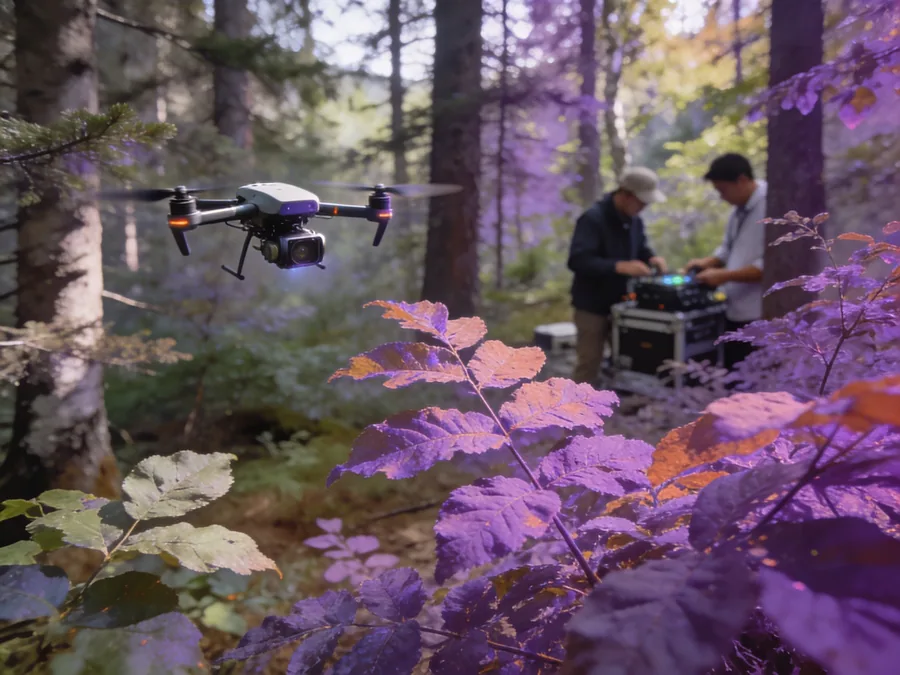
UV light unlocks precise tree species identification for automated forest monitoring. Credit: Perplexity

Research Summary

A recent master's thesis demonstrates that ultraviolet (UV) light, long ignored in ecological remote sensing, is highly effective at identifying tree species. This discovery could pave the way for more cost-effective, automated forest monitoring and agricultural management using hyperspectral imaging technologies.

A New Lens on Forestry: How Trees' Invisible "Sunscreen" Could Revolutionize Commercial Forest Mapping

Research Shock

Published on April 3, 2026 at 9:56 pm

Summary

A recent master's thesis demonstrates that ultraviolet (UV) light, long ignored in ecological remote sensing, is highly effective at identifying tree species. This discovery could pave the way for more cost-effective, automated forest monitoring and agricultural management using hyperspectral imaging technologies.

Every time we step outside, we are bathed in ultraviolet (UV) light. While humans apply sunscreen to protect themselves from this high energy radiation, trees have evolved their own chemical defenses. Now, new research reveals that this invisible plant "sunscreen" could be the key to revolutionizing how the forestry and agricultural industries monitor their lands.

According to a 2026 master's thesis by Alexander Matthew Morgan from the University of New Brunswick, measuring the UV light reflected off tree leaves provides highly accurate data for identifying different tree species.

Hyperspectral Imaging: Beyond Red, Green, and Blue

To understand this breakthrough, we first need to look at the technology used: hyperspectral imaging. Your standard smartphone camera captures the world using just three broad colors: red, green, and blue. A hyperspectral camera, however, splits light into hundreds of incredibly narrow, continuous channels, capturing a detailed "spectral fingerprint" for every pixel.

Historically, this technology has been highly profitable for the geology and mining sectors, which use it to map mineral deposits from aircraft or satellites. However, the forestry industry has been slower to adopt it, often relying only on the visible and near-infrared light spectrums. UV light was largely ignored by researchers because it scatters easily in our atmosphere and reflects very poorly off of leaves.

The UV Breakthrough

Morgan's research challenged this assumption. Using a handheld spectroradiometer, a device that measures precise wavelengths of reflected light, the study analyzed leaf samples from 13 different hardwood and softwood species in Atlantic Canada.

The results were surprising. Even though leaves only reflect a tiny amount of UV light (less than 10%), the UV bands actually provided the highest classification accuracy for identifying the correct tree species, outperforming visible and infrared light.

Why? The answer lies in the plant's cuticle, its outer protective layer. Plants produce specific compounds, like phenolics and flavonoids, to absorb harmful UV radiation and safely dissipate it as heat. Because different tree species produce different types and amounts of these chemical "sunscreens," their UV reflections act as distinct, identifiable signatures.

Economic and Industrial Implications

For the commercial forestry, timber, and agricultural industries, mapping species composition and monitoring plant health is a massive operating expense. Traditional population estimates often require invasive, labor intensive, and costly manual field surveys.

Integrating UV hyperspectral sensors onto drones or airplanes could automate these surveys. This would allow commercial operators to:

  • Map Vast Areas Quickly: Accurately identify tree species across massive tracts of land without deploying ground crews.

  • Detect Crop Stress: Monitor plant health and detect early signs of disease before they ruin crops or timber yields.

  • Lower R&D Costs: Morgan's study highlights a cost-effective pipeline for tech companies. Instead of spending hundreds of millions to launch satellites or fly specialized aircraft immediately, companies can use relatively cheap handheld scanners to prove their concepts and find the exact light bands they need before scaling up.

A Reality Check

While the findings are promising, it is important not to overhype the immediate commercial application. This study was conducted using leaves laid flat on the ground and scanned from close range. Scaling this up to a drone or satellite means dealing with the atmosphere, which scatters UV light heavily, and managing the complex angles and shadows of a real forest canopy.

Nevertheless, discovering that trees have a readable, invisible signature in the ultraviolet spectrum opens a lucrative new frontier for remote sensing technology - one that could make managing our natural resources smarter, cheaper, and far more efficient.

Category

Environment

Tags

Hyperspectral Imaging, Forestry, Remote Sensing, UV Light, AgTech, Precision Agriculture

Disclosure Statement

This article is based on the Master of Science in Forestry thesis "An Investigation of Hyperspectral Technology for Use in Tree Identification" by Alexander Matthew Morgan, University of New Brunswick, 2026.

Research Paper

https://unbscholar.lib.unb.ca/items/96247427-5304-4645-ae9d-fa0175d6cbea

Every time we step outside, we are bathed in ultraviolet (UV) light. While humans apply sunscreen to protect themselves from this high energy radiation, trees have evolved their own chemical defenses. Now, new research reveals that this invisible plant "sunscreen" could be the key to revolutionizing how the forestry and agricultural industries monitor their lands.

According to a 2026 master's thesis by Alexander Matthew Morgan from the University of New Brunswick, measuring the UV light reflected off tree leaves provides highly accurate data for identifying different tree species.

Hyperspectral Imaging: Beyond Red, Green, and Blue

To understand this breakthrough, we first need to look at the technology used: hyperspectral imaging. Your standard smartphone camera captures the world using just three broad colors: red, green, and blue. A hyperspectral camera, however, splits light into hundreds of incredibly narrow, continuous channels, capturing a detailed "spectral fingerprint" for every pixel.

Historically, this technology has been highly profitable for the geology and mining sectors, which use it to map mineral deposits from aircraft or satellites. However, the forestry industry has been slower to adopt it, often relying only on the visible and near-infrared light spectrums. UV light was largely ignored by researchers because it scatters easily in our atmosphere and reflects very poorly off of leaves.

The UV Breakthrough

Morgan's research challenged this assumption. Using a handheld spectroradiometer, a device that measures precise wavelengths of reflected light, the study analyzed leaf samples from 13 different hardwood and softwood species in Atlantic Canada.

The results were surprising. Even though leaves only reflect a tiny amount of UV light (less than 10%), the UV bands actually provided the highest classification accuracy for identifying the correct tree species, outperforming visible and infrared light.

Why? The answer lies in the plant's cuticle, its outer protective layer. Plants produce specific compounds, like phenolics and flavonoids, to absorb harmful UV radiation and safely dissipate it as heat. Because different tree species produce different types and amounts of these chemical "sunscreens," their UV reflections act as distinct, identifiable signatures.

Economic and Industrial Implications

For the commercial forestry, timber, and agricultural industries, mapping species composition and monitoring plant health is a massive operating expense. Traditional population estimates often require invasive, labor intensive, and costly manual field surveys.

Integrating UV hyperspectral sensors onto drones or airplanes could automate these surveys. This would allow commercial operators to:

  • Map Vast Areas Quickly: Accurately identify tree species across massive tracts of land without deploying ground crews.

  • Detect Crop Stress: Monitor plant health and detect early signs of disease before they ruin crops or timber yields.

  • Lower R&D Costs: Morgan's study highlights a cost-effective pipeline for tech companies. Instead of spending hundreds of millions to launch satellites or fly specialized aircraft immediately, companies can use relatively cheap handheld scanners to prove their concepts and find the exact light bands they need before scaling up.

A Reality Check

While the findings are promising, it is important not to overhype the immediate commercial application. This study was conducted using leaves laid flat on the ground and scanned from close range. Scaling this up to a drone or satellite means dealing with the atmosphere, which scatters UV light heavily, and managing the complex angles and shadows of a real forest canopy.

Nevertheless, discovering that trees have a readable, invisible signature in the ultraviolet spectrum opens a lucrative new frontier for remote sensing technology - one that could make managing our natural resources smarter, cheaper, and far more efficient.

Institution

Research Shock

Category

Environment

Tags

Hyperspectral ImagingForestryRemote SensingUV LightAgTechPrecision Agriculture

Disclosure statement

This article is based on the Master of Science in Forestry thesis "An Investigation of Hyperspectral Technology for Use in Tree Identification" by Alexander Matthew Morgan, University of New Brunswick, 2026.

Research Paper

Read the full research paper

Comments (...)

Loading comments...

Institution

Research Shock

Category

Environment

Tags

Hyperspectral ImagingForestryRemote SensingUV LightAgTechPrecision Agriculture

Disclosure statement

This article is based on the Master of Science in Forestry thesis "An Investigation of Hyperspectral Technology for Use in Tree Identification" by Alexander Matthew Morgan, University of New Brunswick, 2026.

Research Paper

Read the full research paper