
iconResearch Shock
Artificial IntelligenceEnvironmentLife SciencesSpaceNeuroscienceEngineeringSocietyTechnologyMedicineBusiness + Innovation

Company

  • Who we are
  • Our team
  • Contact us

Community

  • Community standards
  • Author guidelines

University Partners

  • For Universities
  • For Departments
  • For Research Labs

Legal

  • Privacy policy
  • Terms of service

Follow Us

Copyright © 2025, Research Shock, Inc.

Artificial Intelligence Slashes Heart Ablation Simulation Times from Hours to Milliseconds, Paving the Way for Real-Time Surgical Optimization

Artificial Intelligence Slashes Heart Ablation Simulation Times from Hours to Milliseconds, Paving the Way for Real-Time Surgical Optimization

Research Shock•Loading...
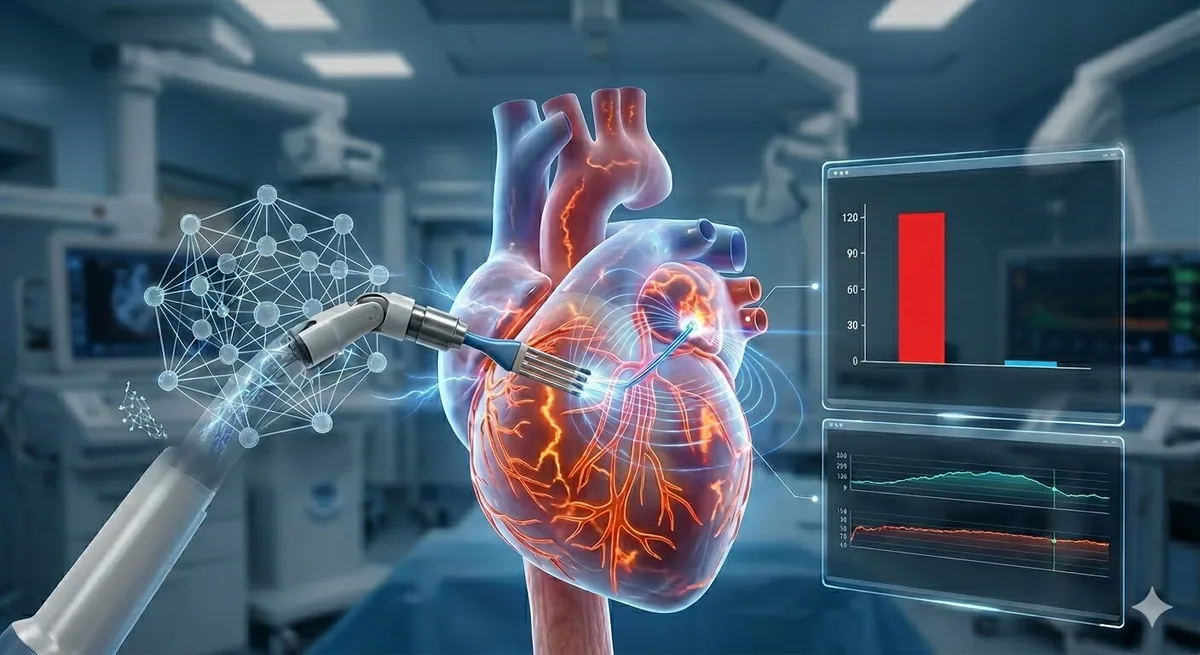
Generated using Gemini

Research Summary

Pulse field ablation (PFA) is an emerging treatment for irregular heartbeats that relies on microsecond-scale, high-voltage electrical fields rather than extreme heat or cold to target problematic tissue. Accurately predicting the perfect dosage and parameters for PFA previously required between 6 and 12 hours of complex computational modeling. However, a new framework integrating machine learning and genetic algorithms has reduced this prediction time to just 1.147 milliseconds. This leap in speed allows for real-time, patient-specific treatment planning during surgeries, offering significant commercial potential for medical device manufacturers seeking to optimize ablation protocols.

Artificial Intelligence Slashes Heart Ablation Simulation Times from Hours to Milliseconds, Paving the Way for Real-Time Surgical Optimization

Research Shock

Published on March 24, 2026 at 7:34 pm

Summary

Pulse field ablation (PFA) is an emerging treatment for irregular heartbeats that relies on microsecond-scale, high-voltage electrical fields rather than extreme heat or cold to target problematic tissue. Accurately predicting the perfect dosage and parameters for PFA previously required between 6 and 12 hours of complex computational modeling. However, a new framework integrating machine learning and genetic algorithms has reduced this prediction time to just 1.147 milliseconds. This leap in speed allows for real-time, patient-specific treatment planning during surgeries, offering significant commercial potential for medical device manufacturers seeking to optimize ablation protocols.

The Shift to Electrical Heart Therapy

Cardiac arrhythmias, characterized by abnormal heart rhythms, remain a major global healthcare challenge. For years, the standard treatment has been thermal ablation, which is a procedure that involves either burning the specific heart tissue above 50°C or freezing it below -20°C to destroy the irregular rhythm. However, tightly controlling these extreme temperatures so they only destroy bad tissue while sparing healthy structures is notoriously difficult.

Enter pulsed field ablation (PFA). Instead of relying on destructive temperatures, PFA uses microsecond-scale, high-voltage electrical bursts to destabilize cell membranes. This process, known as irreversible electroporation, is highly selective and largely non-thermal, meaning it minimizes collateral damage to critical nearby structures like the esophagus and nerves.

An Industrial Bottleneck

The commercial medical technology sector has recognized PFA's massive potential. Several commercial PFA systems have recently secured FDA approval, including devices from heavyweights like Boston Scientific, Medtronic, Johnson & Johnson, Abbott, and Kardium.

Despite this industrial momentum, a major clinical challenge remains: there is currently no consensus on the ideal catheter design, electrical waveform, or exposure duration. To find the perfect treatment parameters, engineers and doctors rely on high-fidelity computational models that simulate electrical, thermal, and fluid dynamics. The problem? A single simulation can take between 6 and 12 hours to complete. This massive delay makes it impossible for surgeons to use these predictive models to adjust treatments on the fly in the operating room.

A Millisecond Breakthrough

A new study published in Results in Engineering by researchers from the University of Prince Edward Island and Wilfrid Laurier University presents a massive leap forward. By combining traditional computational modeling with machine learning (ML) and statistical design, the team trained an AI model to predict PFA outcomes almost instantly.

The researchers tested various algorithms and discovered that a specific type of ML algorithm (a Gaussian process model) exhibited strong predictive performance for both the volume of tissue destroyed and the maximum temperature reached during the procedure. Most impressively, this ML model executed its predictions in just 1.147 milliseconds, effectively turning a half-day computational task into an instantaneous result.

During their analysis, the researchers also pinpointed exactly which machine settings matter most. They found that the electrical voltage (pulse amplitude) and how deep the electrode is inserted (contact depth) are the two most statistically significant factors dictating the success of the ablation.

Economic and Clinical Impact

Economically, this framework is a gamechanger for the medical device industry and clinical operations. By drastically reducing computational time, the AI model can act as an efficient surrogate model that can be rapidly integrated into the clinical workflow for real time decision making.

This means surgeons could soon use software to instantly tweak a machine's voltage and pulse settings to fit a patient's unique anatomy right in the operating room, automatically balancing maximum effectiveness with maximum safety. The researchers note this generalized framework could be used to optimize current commercial PFA systems and be adapted to improve other thermal therapies moving forward.

Category

Medicine

Tags

Artificial Intelligence, Machine Learning, Cardiology, Pulse Field Ablation, PFA, Medical Devices, Bioengineering

Disclosure Statement

The research is supported by the University of Prince Edward Island Start-up and Internal Research Grant 2024, as well as the Natural Sciences and Engineering Research Council (NSERC) of Canada's USRA program.

Research Paper

https://islandscholar.ca/islandora/object/18246

The Shift to Electrical Heart Therapy

Cardiac arrhythmias, characterized by abnormal heart rhythms, remain a major global healthcare challenge. For years, the standard treatment has been thermal ablation, which is a procedure that involves either burning the specific heart tissue above 50°C or freezing it below -20°C to destroy the irregular rhythm. However, tightly controlling these extreme temperatures so they only destroy bad tissue while sparing healthy structures is notoriously difficult.

Enter pulsed field ablation (PFA). Instead of relying on destructive temperatures, PFA uses microsecond-scale, high-voltage electrical bursts to destabilize cell membranes. This process, known as irreversible electroporation, is highly selective and largely non-thermal, meaning it minimizes collateral damage to critical nearby structures like the esophagus and nerves.

An Industrial Bottleneck

The commercial medical technology sector has recognized PFA's massive potential. Several commercial PFA systems have recently secured FDA approval, including devices from heavyweights like Boston Scientific, Medtronic, Johnson & Johnson, Abbott, and Kardium.

Despite this industrial momentum, a major clinical challenge remains: there is currently no consensus on the ideal catheter design, electrical waveform, or exposure duration. To find the perfect treatment parameters, engineers and doctors rely on high-fidelity computational models that simulate electrical, thermal, and fluid dynamics. The problem? A single simulation can take between 6 and 12 hours to complete. This massive delay makes it impossible for surgeons to use these predictive models to adjust treatments on the fly in the operating room.

A Millisecond Breakthrough

A new study published in Results in Engineering by researchers from the University of Prince Edward Island and Wilfrid Laurier University presents a massive leap forward. By combining traditional computational modeling with machine learning (ML) and statistical design, the team trained an AI model to predict PFA outcomes almost instantly.

The researchers tested various algorithms and discovered that a specific type of ML algorithm (a Gaussian process model) exhibited strong predictive performance for both the volume of tissue destroyed and the maximum temperature reached during the procedure. Most impressively, this ML model executed its predictions in just 1.147 milliseconds, effectively turning a half-day computational task into an instantaneous result.

During their analysis, the researchers also pinpointed exactly which machine settings matter most. They found that the electrical voltage (pulse amplitude) and how deep the electrode is inserted (contact depth) are the two most statistically significant factors dictating the success of the ablation.

Economic and Clinical Impact

Economically, this framework is a gamechanger for the medical device industry and clinical operations. By drastically reducing computational time, the AI model can act as an efficient surrogate model that can be rapidly integrated into the clinical workflow for real time decision making.

This means surgeons could soon use software to instantly tweak a machine's voltage and pulse settings to fit a patient's unique anatomy right in the operating room, automatically balancing maximum effectiveness with maximum safety. The researchers note this generalized framework could be used to optimize current commercial PFA systems and be adapted to improve other thermal therapies moving forward.

Institution

Research Shock

Category

Medicine

Tags

Artificial IntelligenceMachine LearningCardiologyPulse Field AblationPFAMedical DevicesBioengineering

Disclosure statement

The research is supported by the University of Prince Edward Island Start-up and Internal Research Grant 2024, as well as the Natural Sciences and Engineering Research Council (NSERC) of Canada's USRA program.

Research Paper

Read the full research paper

Comments (...)

Loading comments...

Institution

Research Shock

Category

Medicine

Tags

Artificial IntelligenceMachine LearningCardiologyPulse Field AblationPFAMedical DevicesBioengineering

Disclosure statement

The research is supported by the University of Prince Edward Island Start-up and Internal Research Grant 2024, as well as the Natural Sciences and Engineering Research Council (NSERC) of Canada's USRA program.

Research Paper

Read the full research paper