
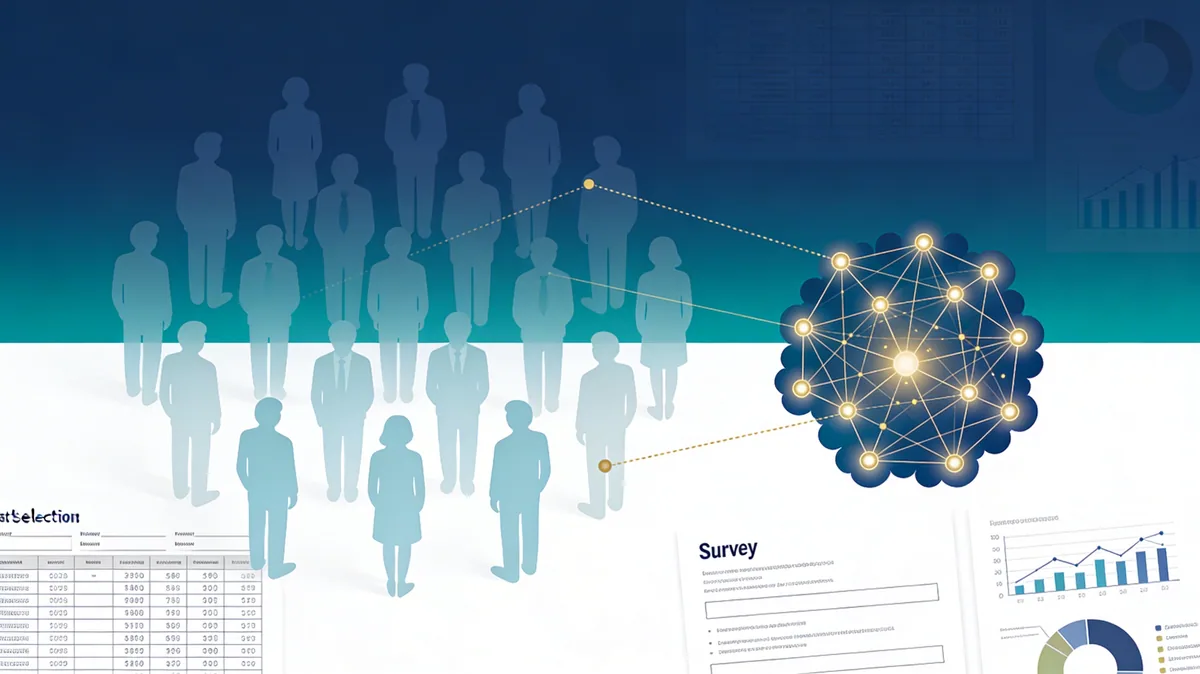
In today's data driven economy, uncovering deep, actionable insights usually requires an enormous budget. Testing genetic markers, utilizing expensive medical biomarkers, or conducting hours-long dietary interviews is simply too costly to perform on tens of thousands of people.
To solve this, researchers often use a cost-saving strategy called a "two-phase design". In the first phase, cheap and easily accessible information (like basic demographics or routine clinic measurements) is gathered from a massive group of people. In the second phase, a much smaller subset of that group is selected to undergo the highly expensive, precise measurements.
The fundamental challenge (and where millions of dollars in research budgets can be wasted) is deciding exactly who makes the cut for that small, expensive second phase.
The Breakthrough: Optimizing "Coarsened" Data
Statisticians have long known how to perfectly optimize this second phase if the cheap initial data naturally falls into neat, discrete categories, like "smoker" versus "non-smoker".
However, real world data is rarely that simple; it is often continuous, taking the form of exact ages, precise body weights, or fluctuating blood pressure readings. When researchers face this continuous data, they typically have to group or "coarsen" it into brackets, such as dividing ages into quartiles or grouping weights into ranges.
Historically, there hasn't been a formal mathematical framework to guarantee you were selecting the absolute most informative people once that continuous data was grouped. Researchers were essentially making educated guesses on how to sample from these brackets.
Aadesh Nunkoo, in a 2026 Master of Science thesis at the University of Prince Edward Island, has solved this specific mathematical gap. His thesis developed a general framework that provides mathematically optimal sampling probabilities for these grouped, continuous variables. Crucially, his research proves that optimizing this grouped data doesn't require complex, burdensome new modeling assumptions; it relies on the same foundational math used for naturally categorized data.
Proving It Works in the Real World
To prove the framework's real-world viability, the study replicated an analysis using data from the 2015-2016 National Health and Nutrition Examination Survey (NHANES).
The goal was to estimate the relationship between Body Mass Index (BMI) and blood pressure, while adjusting for dietary factors like sodium and fat intake. Because dietary data requires expensive, labor-intensive interviews, the budget only allowed roughly 20 percent of the 6,453 participants to be interviewed.
By applying this new optimal sampling design, the framework consistently outperformed traditional, non-adaptive sampling methods (like randomly selecting an equal or proportional number of people from each bracket). It produced highly accurate estimates without needing to expand the testing budget.
Furthermore, because finding the true "optimal" design technically requires knowing unknown variables ahead of time, Nunkoo included a practical "two stage adaptive" workaround. This allows researchers to test a small initial batch of people to mathematically calibrate the rest of their sampling strategy, saving them the cost of running a separate, expensive pilot study just to figure out the math.
Economic and Industrial Impact
This mathematical advancement is not just academic theory; it has direct economic applications for any industry that relies on expensive testing:
Healthcare and Clinical Trials: The framework can drastically lower trial costs by using cheap auxiliary data (like basic electronic health records) to pinpoint exactly which patients will yield the most informative results from expensive genome sequencing.
Biomarker Research: Studies analyzing how diseases progress can use the framework to efficiently select patients for expensive biomarker testing, maximizing tight research budgets.
Data Cleanup and Auditing: In settings involving measurement errors, companies can mathematically optimize which specific, error-prone digital records to pull for expensive manual human validation.
By providing a reliable, mathematically sound way to "coarsen" data and sample from it, this framework allows research institutions and massive corporations to squeeze the maximum amount of insight out of every dollar spent.