
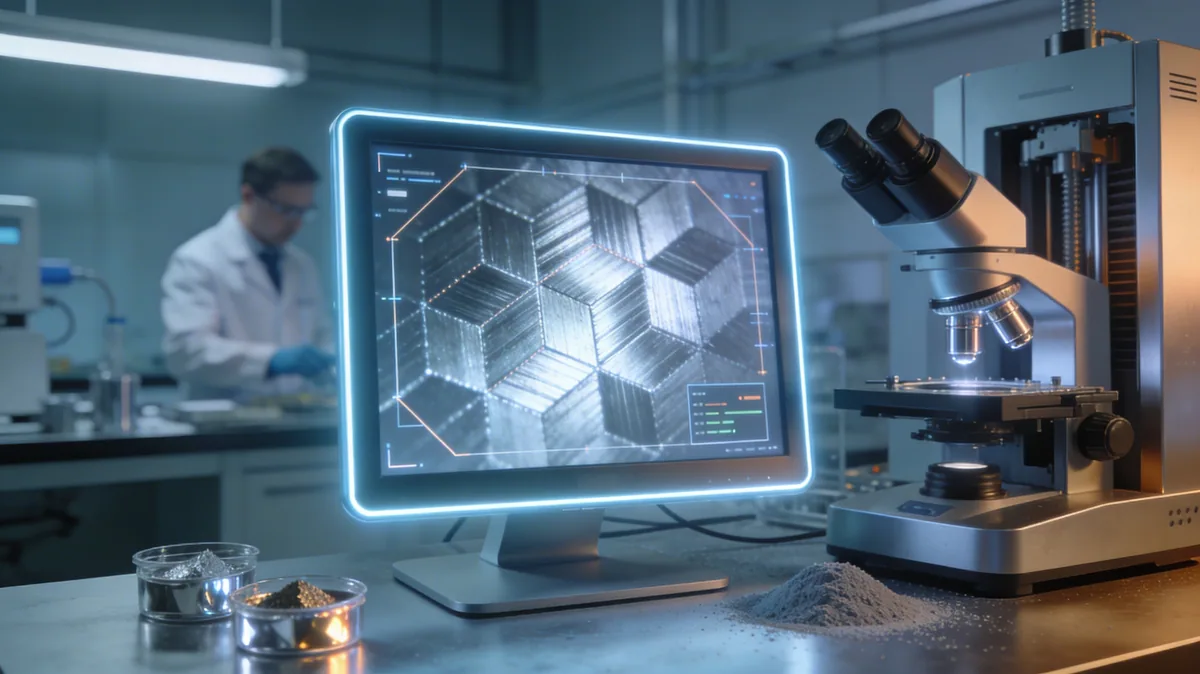
The next generation of aerospace, marine, and defense technologies relies on materials that can survive extreme environments. Enter High-Entropy Alloys (HEAs). Unlike traditional metals, which rely heavily on a single base element like iron or aluminum, HEAs are created by mixing five or more metals in roughly equal proportions to achieve exceptional strength and thermal resistance.
But manufacturing these "super-metals" presents a massive economic and industrial hurdle: ensuring the metals are perfectly mixed. A recent master's thesis by Keshav Palanchu at the University of New Brunswick outlines a novel Artificial Intelligence (AI) solution that could drastically lower the cost of quality control for these advanced materials.
The Industrial Bottleneck
To make HEA powders for additive manufacturing (like 3D printing), many small-scale industries and labs use a highly cost-effective method called "mechanical alloying". This process repeatedly smashes metal powders together using steel balls until they bond at a microscopic level.
While this is much cheaper than melting the metals down in high end vacuum facilities, it often results in "inhomogeneous" powders - meaning some particles are perfectly mixed, while others remain partially unmixed with rich pockets of a single element.
In 3D printing, millions of these tiny powder particles act as the fundamental building blocks of a final component. "Even if a tiny fraction of these particles is segregated or poorly alloyed, this can severely affect the mechanical properties and thermal stability of the product," leading to catastrophic failures in critical aerospace or defense parts.
To prevent this, industries traditionally test the powder using a technique called SEM-EDS (Scanning Electron Microscopy combined with Energy-Dispersive X-ray Spectroscopy). However, this chemical analysis is notoriously time-consuming, expensive, and difficult to scale across massive batches of powder.
An AI Solution to Cut Costs
Palanchu’s research proposes a way to bypass the slow and expensive EDS chemical analysis entirely. By training a Deep Learning model (specifically, an architecture known as DenseNet121) on highly detailed, black-and-white microscopic pictures of the powder particles, the AI learned to predict the chemical mixing quality simply by looking at the physical shape and texture of the particles.
The model measures the "Shannon entropy" (a mathematical way to score the compositional uniformity of the AlCoCrFeNi alloy particles on a continuous scale) and does so with remarkable accuracy, achieving a 91.8% reliability score with an average deviation of only about 3%.
What This Means for the Economy and Manufacturing
By proving that the physical morphology of a powder particle carries direct cues about its internal chemical makeup, this AI tool allows for rapid, automated screening.
For the industry, the economic implications are significant:
Lowering the Barrier to Entry: Laboratories and smaller manufacturers equipped with basic, bench-top electron microscopes (without expensive EDS chemical detectors) can now reliably check their powder quality.
Process Optimization: Manufacturers can quickly perform consistency checks between different batches of powder, tweaking their milling machines in real-time to avoid wasting money on bad powder.
Safer 3D Printing: By rapidly screening out poorly mixed batches before they enter a 3D printer, companies can drastically reduce the risk of structural failures in high stakes environments.
The research operates as a powerful decision-support tool, democratizing the production of advanced materials and ensuring that the high-performance alloys of tomorrow can be manufactured safely, consistently, and affordably today.