
iconResearch Shock
Artificial IntelligenceEnvironmentLife SciencesSpaceNeuroscienceEngineeringSocietyTechnologyMedicineBusiness + Innovation

Company

  • Who we are
  • Our team
  • Contact us

Community

  • Community standards
  • Author guidelines

University Partners

  • For Universities
  • For Departments
  • For Research Labs

Legal

  • Privacy policy
  • Terms of service

Follow Us

Copyright © 2025, Research Shock, Inc.

In-Home Sleep Tech Shows Promise for Cancer Survivors, Pointing to a Shift in Sleep Economics

In-Home Sleep Tech Shows Promise for Cancer Survivors, Pointing to a Shift in Sleep Economics

Research Shock•Loading...
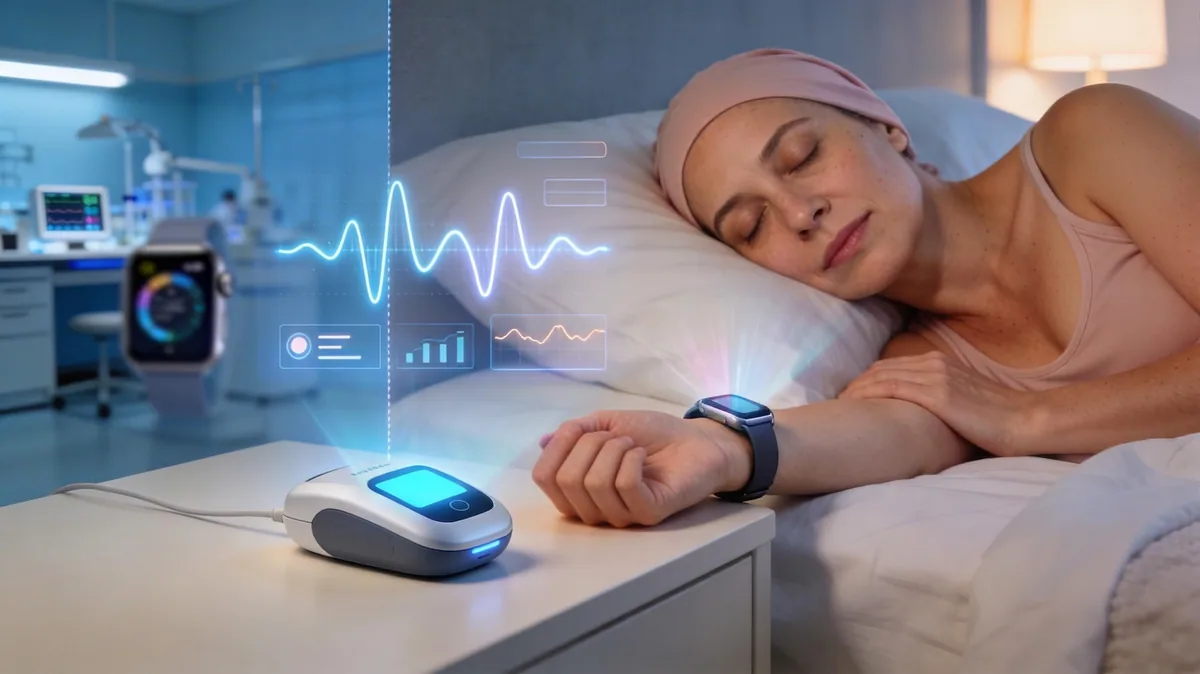
Restful recovery at home. Credit: Perplexity

Research Summary

A recent pilot study investigates the use of an in-home, medical grade sleep tracking device to monitor insomnia treatment in breast cancer survivors. The findings highlight a commercial opportunity to bridge the gap between inaccurate consumer smartwatches and expensive sleep labs. By effectively treating and tracking sleep disorders at home, the healthcare industry could recover significant economic losses linked to sleep deprivation and absenteeism in the workforce.

In-Home Sleep Tech Shows Promise for Cancer Survivors, Pointing to a Shift in Sleep Economics

Research Shock

Published on March 28, 2026 at 2:48 am

Summary

A recent pilot study investigates the use of an in-home, medical grade sleep tracking device to monitor insomnia treatment in breast cancer survivors. The findings highlight a commercial opportunity to bridge the gap between inaccurate consumer smartwatches and expensive sleep labs. By effectively treating and tracking sleep disorders at home, the healthcare industry could recover significant economic losses linked to sleep deprivation and absenteeism in the workforce.

While surviving cancer is a monumental victory, the aftermath often leaves patients grappling with chronic, debilitating side effects. Among breast cancer survivors, up to 36% meet the clinical diagnostic criteria for insomnia disorder immediately after treatment.

This isn't just a quality-of-life issue; it is an economic one. Sleep disturbance accounts for a significant percentage of the impact cancer has on broader healthcare expenses and absenteeism from work. In Canada, for example, 40.6% of individuals with insomnia report experiencing reduced workplace productivity compared to just 12.3% of good sleepers.

Treating insomnia effectively is crucial but tracking that treatment has traditionally faced a major technological and financial bottleneck.

The Tech Gap: Smartwatches vs. Sleep Labs

To truly understand if an insomnia treatment is working, doctors look at "objective sleep." This requires polysomnography (PSG), considered the gold standard in sleep medicine because it physically measures brain waves (electrophysiology) to map out sleep stages.

However, traditional PSG is an industrial bottleneck. It requires patients to sleep in a laboratory, and it demands specialized technologists to manually score the data, making it incredibly expensive and time consuming.

Consumers have turned to wearable devices like smart wristwatches, which overcome the cost and time limitations. But for clinical use, they fall short. Wearables are notoriously less accurate than PSG when measuring time in different sleep stages, especially for individuals who toss and turn or take a long time to fall asleep.

A Decentralized Solution: In-Home PSG

A 2026 Master’s thesis by Emily A. White at Memorial University of Newfoundland tested a middle-ground solution: the Cerebra Sleep System.

The Cerebra Sleep System is an in-home PSG device that patients apply themselves. Crucially for the healthcare industry, it utilizes automatic scoring software. This reduces the amount of time, effort, and specialized personnel required compared to traditional in-lab sleep studies, while maintaining clinical accuracy.

White’s pilot study tested this device on a group of breast cancer survivors undergoing a highly effective, structured behavioral treatment called Cognitive Behavioral Therapy for Insomnia (CBT-I).

The clinical results were highly positive:

  • CBT-I significantly improved subjective and objective sleep efficiency, which is the percentage of time spent in bed actually sleeping.

  • The time patients spent awake during the night after initially falling asleep also significantly decreased.

  • Participants self-reported a clinically meaningful reduction in their insomnia severity.

Design Hurdles for Mass Commercialization

While the technology proved technically feasible (with 82.6% of first-night attempts yielding successful clinical data) the study revealed important user experience (UX) hurdles that medical device manufacturers must overcome for mass adoption.

  • Ergonomics: Some participants reported feeling anxious about applying the sensors correctly and noted that the forehead attachment was awkward or uncomfortable.

  • Biological Realities: Three of the four first-night failures were due to night sweats, a common side effect of cancer treatments. Perspiration made it difficult to keep the forehead unit attached. Researchers noted that a solution to this, such as an anti-perspirant for the forehead or a hardware redesign, is needed for this demographic.

The Bottom Line

The future of sleep medicine lies outside the laboratory. By refining the hardware of in-home PSG devices to be more comfortable and resilient to human factors like perspiration, the health tech industry can democratize clinical-grade sleep tracking. Doing so won't just improve the lives of cancer survivors; it provides a scalable way to treat chronic insomnia, ultimately clawing back the massive economic losses associated with a tired workforce.

Category

Medicine

Tags

Health Tech, Insomnia, Breast Cancer, Medical Devices

Disclosure Statement

This article is based on the Master of Science thesis, "A Pilot Study of a Novel Sleep Scoring System to Measure Insomnia Treatment Response in Breast Cancer Survivors," authored by Emily A. White at Memorial University of Newfoundland, published in February 2026.

Research Paper

https://memorial.scholaris.ca/items/e6a0b3ff-3295-4f32-ba64-8e40c3f883ec

While surviving cancer is a monumental victory, the aftermath often leaves patients grappling with chronic, debilitating side effects. Among breast cancer survivors, up to 36% meet the clinical diagnostic criteria for insomnia disorder immediately after treatment.

This isn't just a quality-of-life issue; it is an economic one. Sleep disturbance accounts for a significant percentage of the impact cancer has on broader healthcare expenses and absenteeism from work. In Canada, for example, 40.6% of individuals with insomnia report experiencing reduced workplace productivity compared to just 12.3% of good sleepers.

Treating insomnia effectively is crucial but tracking that treatment has traditionally faced a major technological and financial bottleneck.

The Tech Gap: Smartwatches vs. Sleep Labs

To truly understand if an insomnia treatment is working, doctors look at "objective sleep." This requires polysomnography (PSG), considered the gold standard in sleep medicine because it physically measures brain waves (electrophysiology) to map out sleep stages.

However, traditional PSG is an industrial bottleneck. It requires patients to sleep in a laboratory, and it demands specialized technologists to manually score the data, making it incredibly expensive and time consuming.

Consumers have turned to wearable devices like smart wristwatches, which overcome the cost and time limitations. But for clinical use, they fall short. Wearables are notoriously less accurate than PSG when measuring time in different sleep stages, especially for individuals who toss and turn or take a long time to fall asleep.

A Decentralized Solution: In-Home PSG

A 2026 Master’s thesis by Emily A. White at Memorial University of Newfoundland tested a middle-ground solution: the Cerebra Sleep System.

The Cerebra Sleep System is an in-home PSG device that patients apply themselves. Crucially for the healthcare industry, it utilizes automatic scoring software. This reduces the amount of time, effort, and specialized personnel required compared to traditional in-lab sleep studies, while maintaining clinical accuracy.

White’s pilot study tested this device on a group of breast cancer survivors undergoing a highly effective, structured behavioral treatment called Cognitive Behavioral Therapy for Insomnia (CBT-I).

The clinical results were highly positive:

  • CBT-I significantly improved subjective and objective sleep efficiency, which is the percentage of time spent in bed actually sleeping.

  • The time patients spent awake during the night after initially falling asleep also significantly decreased.

  • Participants self-reported a clinically meaningful reduction in their insomnia severity.

Design Hurdles for Mass Commercialization

While the technology proved technically feasible (with 82.6% of first-night attempts yielding successful clinical data) the study revealed important user experience (UX) hurdles that medical device manufacturers must overcome for mass adoption.

  • Ergonomics: Some participants reported feeling anxious about applying the sensors correctly and noted that the forehead attachment was awkward or uncomfortable.

  • Biological Realities: Three of the four first-night failures were due to night sweats, a common side effect of cancer treatments. Perspiration made it difficult to keep the forehead unit attached. Researchers noted that a solution to this, such as an anti-perspirant for the forehead or a hardware redesign, is needed for this demographic.

The Bottom Line

The future of sleep medicine lies outside the laboratory. By refining the hardware of in-home PSG devices to be more comfortable and resilient to human factors like perspiration, the health tech industry can democratize clinical-grade sleep tracking. Doing so won't just improve the lives of cancer survivors; it provides a scalable way to treat chronic insomnia, ultimately clawing back the massive economic losses associated with a tired workforce.

Institution

Research Shock

Category

Medicine

Tags

Health TechInsomniaBreast CancerMedical Devices

Disclosure statement

This article is based on the Master of Science thesis, "A Pilot Study of a Novel Sleep Scoring System to Measure Insomnia Treatment Response in Breast Cancer Survivors," authored by Emily A. White at Memorial University of Newfoundland, published in February 2026.

Research Paper

Read the full research paper

Comments (...)

Loading comments...

Institution

Research Shock

Category

Medicine

Tags

Health TechInsomniaBreast CancerMedical Devices

Disclosure statement

This article is based on the Master of Science thesis, "A Pilot Study of a Novel Sleep Scoring System to Measure Insomnia Treatment Response in Breast Cancer Survivors," authored by Emily A. White at Memorial University of Newfoundland, published in February 2026.

Research Paper

Read the full research paper