
iconResearch Shock
Artificial IntelligenceEnvironmentLife SciencesSpaceNeuroscienceEngineeringSocietyTechnologyMedicineBusiness + Innovation

Company

  • Who we are
  • Our team
  • Contact us

Community

  • Community standards
  • Author guidelines

University Partners

  • For Universities
  • For Departments
  • For Research Labs

Legal

  • Privacy policy
  • Terms of service

Follow Us

Copyright © 2025, Research Shock, Inc.

"Just Add Water": How a New Green Cement Could Transform the Construction Industry and Slash Carbon Emissions

"Just Add Water": How a New Green Cement Could Transform the Construction Industry and Slash Carbon Emissions

Research Shock•Loading...
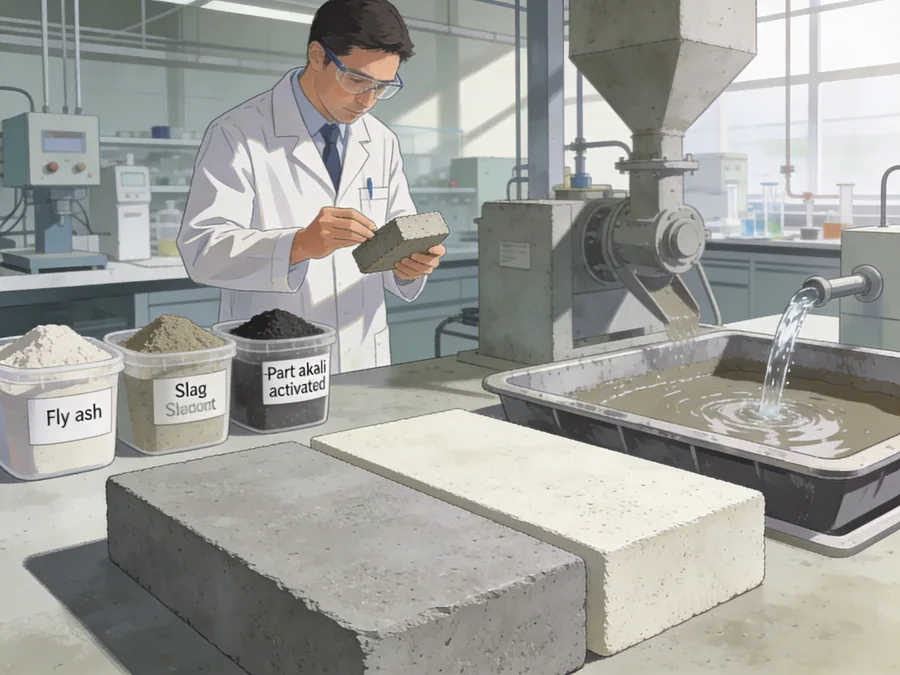
A lower-carbon concrete breakthrough using industrial waste and water. Credit: Perplexity

Research Summary

Cement production is responsible for a staggering 8% of global CO2 emissions. A recent PhD dissertation from Concordia University highlights a breakthrough in sustainable construction: "one-part" Alkali-Activated Materials (AAMs). By utilizing industrial waste and a "just add water" approach, this green alternative mimics traditional cement while cutting carbon emissions by 73%. The research solves long-standing issues with the material drying too quickly, paving the way for its widespread adoption in the ready-mix concrete industry and offering significant economic and safety benefits.

"Just Add Water": How a New Green Cement Could Transform the Construction Industry and Slash Carbon Emissions

Research Shock

Published on April 3, 2026 at 3:48 am

Summary

Cement production is responsible for a staggering 8% of global CO2 emissions. A recent PhD dissertation from Concordia University highlights a breakthrough in sustainable construction: "one-part" Alkali-Activated Materials (AAMs). By utilizing industrial waste and a "just add water" approach, this green alternative mimics traditional cement while cutting carbon emissions by 73%. The research solves long-standing issues with the material drying too quickly, paving the way for its widespread adoption in the ready-mix concrete industry and offering significant economic and safety benefits.

As nations worldwide (including Canada) race to meet net zero greenhouse gas emissions by 2050, the construction sector is facing a monumental challenge. Traditional cement, known as Ordinary Portland Cement (OPC), is a carbon heavy giant. Its production alone consumes roughly 40% of global energy and emits nearly 8% of the world’s carbon dioxide. Finding a sustainable, economically viable alternative is no longer just an environmental goal; it is an industrial necessity.

Enter Alkali-Activated Materials (AAMs), a promising green alternative. AAMs completely bypass the traditional carbon heavy cement making process. Instead, they are created by taking industrial byproducts, such as "slag," a waste material left over from iron manufacturing, and mixing them with high-alkaline chemicals (activators) to trigger a hardening reaction.

According to a 2025 PhD dissertation by Nourhan Ali at Concordia University, switching to slag based AAMs can yield a remarkable 73% reduction in greenhouse gases and a 43% decrease in energy demand compared to traditional cement. Better yet, it repurposes thousands of tons of industrial waste that would otherwise take up space in landfills.

The "Just Add Water" Breakthrough

While AAMs have existed for years, they historically came with a major logistical and economic hurdle. Traditional AAMs (called "two-part" systems) require workers to mix the industrial waste with highly corrosive, viscous liquid chemical solutions on-site. Transporting and handling these hazardous liquids requires specialized equipment and heightened labor safety protocols, driving up costs and limiting widespread commercial use.

The industry's solution is the "one-part" AAM system. Often dubbed "just add water" cement, this method uses a solid powder activator instead of a hazardous liquid. By combining all the necessary components into a single dry mix, construction crews can simply add water onsite, perfectly mimicking how traditional cement is handled today. Economically, this "one-part" approach significantly lowers transportation, storage, and equipment costs while virtually eliminating the chemical safety risks for workers.

Solving the "Flowability" Problem

If one-part AAMs are so efficient and cheap to transport, why aren't they everywhere? The primary barrier to commercialization has been what engineers call "poor flowability" and "rapid slump loss." In simple terms: the green cement hardens much too fast. For the massive Ready-Mix Concrete (RMC) industry, which relies on mixing concrete in trucks and transporting it to construction sites, a material that hardens in the truck before it can be poured is entirely unworkable.

Nourhan Ali’s research successfully tackled this barrier. Through extensive testing, the research identified the exact protocols needed to keep this green cement flowable and easy to work with for longer periods.

Key industrial solutions identified in the research include:

  • Optimal Mixing Sequences: The study found that strictly dry mixing the industrial slag and the powder activator together before adding water yields the best chemical reaction, balancing the setting time and heat generation.

  • Mixing Times: While traditional cement allows for up to 90 minutes of mixing in delivery trucks, the research established that one-part AAMs reach their optimal flow retention at shorter continuous mixing times, which can save energy for Ready Mix Concrete manufacturers.

  • Chemical "Retarders": To stop the cement from hardening too fast, the research tested various chemical additives. It found that adding tiny amounts of specific retarders, namely nano zinc oxide and borax, acts as a temporary barrier, slowing down the chemical reaction just enough to give workers the time they need to pour and mold the concrete without sacrificing its final, ultra-high strength.

The Economic Bottom Line

The implications of this research are highly significant for the economics of construction. By optimizing the "just add water" green cement, manufacturers can now produce a product that fits seamlessly into existing supply chains and machinery.

Construction companies will not need to invest in new, specialized equipment or retrain their labor force to handle dangerous liquids. Furthermore, by transforming industrial waste like iron slag into a high-value building material, the industry can create a profitable circular economy.

As the regulatory pressure to reduce carbon footprints intensifies, optimized one-part AAMs offer the construction industry a viable, cost-effective path to build the future without destroying the climate.

Category

Engineering

Tags

Green Cement, Sustainable Construction, Net-Zero 2050, Circular Economy, Alkali-Activated Materials, Industrial Innovation

Disclosure Statement

This article is based entirely on the 2025 PhD dissertation "Flowable One-Part Alkali Activated Materials: Challenges and Techniques" authored by Nourhan Ali at the Department of Building, Civil and Environmental Engineering, Concordia University, Montreal, Quebec, Canada.

Research Paper

https://spectrum.library.concordia.ca/id/eprint/996224/

As nations worldwide (including Canada) race to meet net zero greenhouse gas emissions by 2050, the construction sector is facing a monumental challenge. Traditional cement, known as Ordinary Portland Cement (OPC), is a carbon heavy giant. Its production alone consumes roughly 40% of global energy and emits nearly 8% of the world’s carbon dioxide. Finding a sustainable, economically viable alternative is no longer just an environmental goal; it is an industrial necessity.

Enter Alkali-Activated Materials (AAMs), a promising green alternative. AAMs completely bypass the traditional carbon heavy cement making process. Instead, they are created by taking industrial byproducts, such as "slag," a waste material left over from iron manufacturing, and mixing them with high-alkaline chemicals (activators) to trigger a hardening reaction.

According to a 2025 PhD dissertation by Nourhan Ali at Concordia University, switching to slag based AAMs can yield a remarkable 73% reduction in greenhouse gases and a 43% decrease in energy demand compared to traditional cement. Better yet, it repurposes thousands of tons of industrial waste that would otherwise take up space in landfills.

The "Just Add Water" Breakthrough

While AAMs have existed for years, they historically came with a major logistical and economic hurdle. Traditional AAMs (called "two-part" systems) require workers to mix the industrial waste with highly corrosive, viscous liquid chemical solutions on-site. Transporting and handling these hazardous liquids requires specialized equipment and heightened labor safety protocols, driving up costs and limiting widespread commercial use.

The industry's solution is the "one-part" AAM system. Often dubbed "just add water" cement, this method uses a solid powder activator instead of a hazardous liquid. By combining all the necessary components into a single dry mix, construction crews can simply add water onsite, perfectly mimicking how traditional cement is handled today. Economically, this "one-part" approach significantly lowers transportation, storage, and equipment costs while virtually eliminating the chemical safety risks for workers.

Solving the "Flowability" Problem

If one-part AAMs are so efficient and cheap to transport, why aren't they everywhere? The primary barrier to commercialization has been what engineers call "poor flowability" and "rapid slump loss." In simple terms: the green cement hardens much too fast. For the massive Ready-Mix Concrete (RMC) industry, which relies on mixing concrete in trucks and transporting it to construction sites, a material that hardens in the truck before it can be poured is entirely unworkable.

Nourhan Ali’s research successfully tackled this barrier. Through extensive testing, the research identified the exact protocols needed to keep this green cement flowable and easy to work with for longer periods.

Key industrial solutions identified in the research include:

  • Optimal Mixing Sequences: The study found that strictly dry mixing the industrial slag and the powder activator together before adding water yields the best chemical reaction, balancing the setting time and heat generation.

  • Mixing Times: While traditional cement allows for up to 90 minutes of mixing in delivery trucks, the research established that one-part AAMs reach their optimal flow retention at shorter continuous mixing times, which can save energy for Ready Mix Concrete manufacturers.

  • Chemical "Retarders": To stop the cement from hardening too fast, the research tested various chemical additives. It found that adding tiny amounts of specific retarders, namely nano zinc oxide and borax, acts as a temporary barrier, slowing down the chemical reaction just enough to give workers the time they need to pour and mold the concrete without sacrificing its final, ultra-high strength.

The Economic Bottom Line

The implications of this research are highly significant for the economics of construction. By optimizing the "just add water" green cement, manufacturers can now produce a product that fits seamlessly into existing supply chains and machinery.

Construction companies will not need to invest in new, specialized equipment or retrain their labor force to handle dangerous liquids. Furthermore, by transforming industrial waste like iron slag into a high-value building material, the industry can create a profitable circular economy.

As the regulatory pressure to reduce carbon footprints intensifies, optimized one-part AAMs offer the construction industry a viable, cost-effective path to build the future without destroying the climate.

Institution

Research Shock

Category

Engineering

Tags

Green CementSustainable ConstructionNet-Zero 2050Circular EconomyAlkali-Activated MaterialsIndustrial Innovation

Disclosure statement

This article is based entirely on the 2025 PhD dissertation "Flowable One-Part Alkali Activated Materials: Challenges and Techniques" authored by Nourhan Ali at the Department of Building, Civil and Environmental Engineering, Concordia University, Montreal, Quebec, Canada.

Research Paper

Read the full research paper

Comments (...)

Loading comments...

Institution

Research Shock

Category

Engineering

Tags

Green CementSustainable ConstructionNet-Zero 2050Circular EconomyAlkali-Activated MaterialsIndustrial Innovation

Disclosure statement

This article is based entirely on the 2025 PhD dissertation "Flowable One-Part Alkali Activated Materials: Challenges and Techniques" authored by Nourhan Ali at the Department of Building, Civil and Environmental Engineering, Concordia University, Montreal, Quebec, Canada.

Research Paper

Read the full research paper