
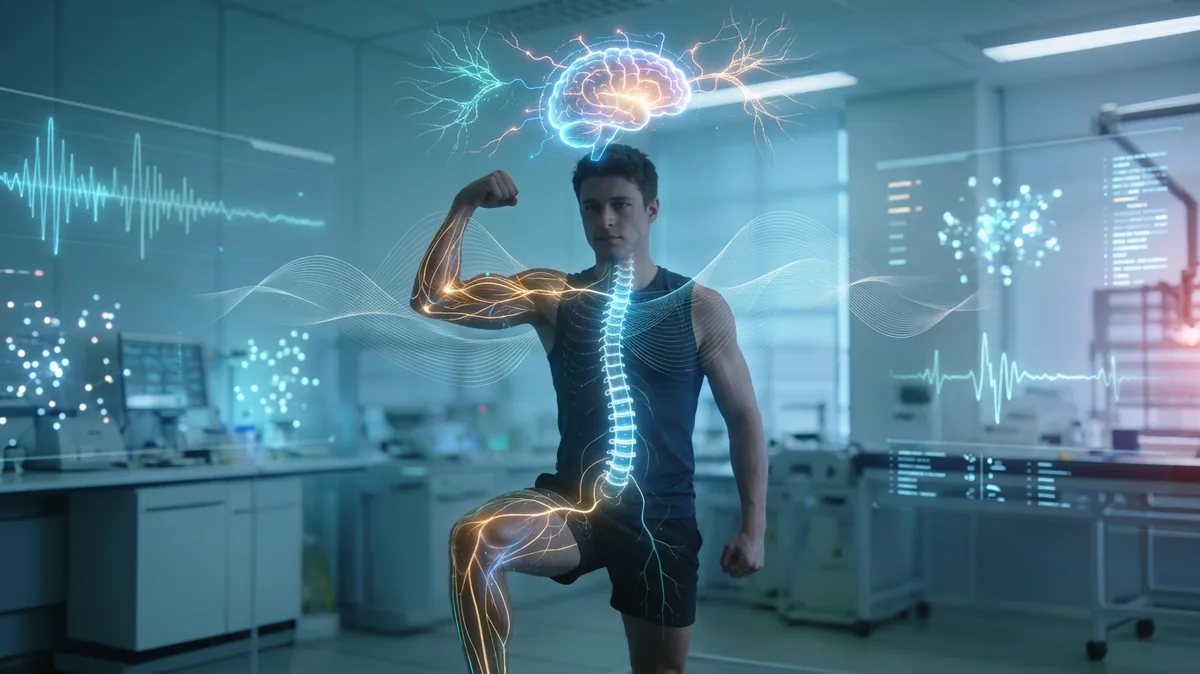
When an athlete pushes through a heavy lift, or a patient struggles to regain strength after an injury, where is the bottleneck? Is the muscle itself too weak, or is the brain simply failing to send a strong enough signal down the spine?
According to 2025 research from Dalhousie University’s Biodynamics, Ergonomics, and Neuroscience Laboratory (BENLab), the key to answering these questions lies in looking at the entire nervous system at once. A recent feasibility study led by researcher Connor Stadnyk tested a specialized data acquisition system designed to stimulate and measure three distinct points along the human motor pathway during physical exertion.
The Science: Separating the Brain from the Brawn
Human movement is driven by the corticospinal tract (CST), a neurological highway that carries commands from the motor cortex in the brain, down through the spinal cord, and out to the muscles. To understand how this system adapts to stress, the researchers used a "tri-modal" stimulation approach:
Transcranial Magnetic Stimulation (TMS): A magnetic coil placed over the scalp safely stimulates the brain to measure the initial motor command.
Thoracolumbar Spinal Stimulation (TSS): Electrical stimulation applied to the back assesses the responsiveness of the spinal cord.
Peripheral Nerve Stimulation (PNS): Electrical stimulation at the hip measures the maximum electrical response the leg muscle can physically produce.
By measuring these three areas while participants performed isometric knee extensions (leg flexes) at various intensities, researchers can calculate exactly how much of a muscle's output comes from the brain versus the spine or the muscle itself.
Industrial and Economic Implications
While currently in the developmental phase, this type of research lays the groundwork for significant advancements in the sports, health, and medical technology industries.
Being able to differentiate between cortical (brain) and spinal adaptations is vital for understanding changes resulting from physical training, muscle fatigue, or neurological injury. From an industrial perspective, hardware and diagnostic protocols built on this framework could allow physical therapists to tailor rehabilitation specifically to a patient's neural deficits, potentially reducing healthcare costs and recovery times. Furthermore, in the sports technology sector, strength and conditioning coaches could use these insights to monitor central nervous system fatigue versus muscular fatigue, optimizing resistance training to prevent overtraining and injury.
Overcoming Hardware Hurdles
As a feasibility study, the primary goal was to see if this complex, simultaneous testing was actually viable. The study aimed to successfully test the protocol on 80% (four out of five) of its participants.
The system hit some technical snags and only acquired complete data from three of the five participants, meaning the strict feasibility criteria were not met. However, the study led to significant hardware and software innovations that will improve future industrial and clinical equipment:
Hardware "Blanking": The large electrical pulses used to stimulate the nerves can temporarily overload recording equipment, hiding the body's natural electrical signals. The team implemented a "blanking" circuit that temporarily mutes the amplifier for just 4 milliseconds during the electrical pulse, successfully preserving the integrity of the muscle's data.
Conditional Force Triggers: Instead of researchers manually triggering a stimulation, they programmed a system that only fires when a patient holds their muscle at an exact, stable force level for a specific amount of time. This automation greatly reduces human error and variability, which is crucial for commercial medical diagnostics.
While the researchers noted that future iterations may require stronger peripheral stimulators and different magnetic coil shapes for the brain, the study marks a critical step forward in tracking human performance from the mind to the muscle.