
iconResearch Shock
Artificial IntelligenceEnvironmentLife SciencesSpaceNeuroscienceEngineeringSocietyTechnologyMedicineBusiness + Innovation

Company

  • Who we are
  • Our team
  • Contact us

Community

  • Community standards
  • Author guidelines

University Partners

  • For Universities
  • For Departments
  • For Research Labs

Legal

  • Privacy policy
  • Terms of service

Follow Us

Copyright © 2025, Research Shock, Inc.

New AI Approach to Mobile App Testing Promises to Slash Development Bottlenecks

New AI Approach to Mobile App Testing Promises to Slash Development Bottlenecks

Research Shock•Loading...
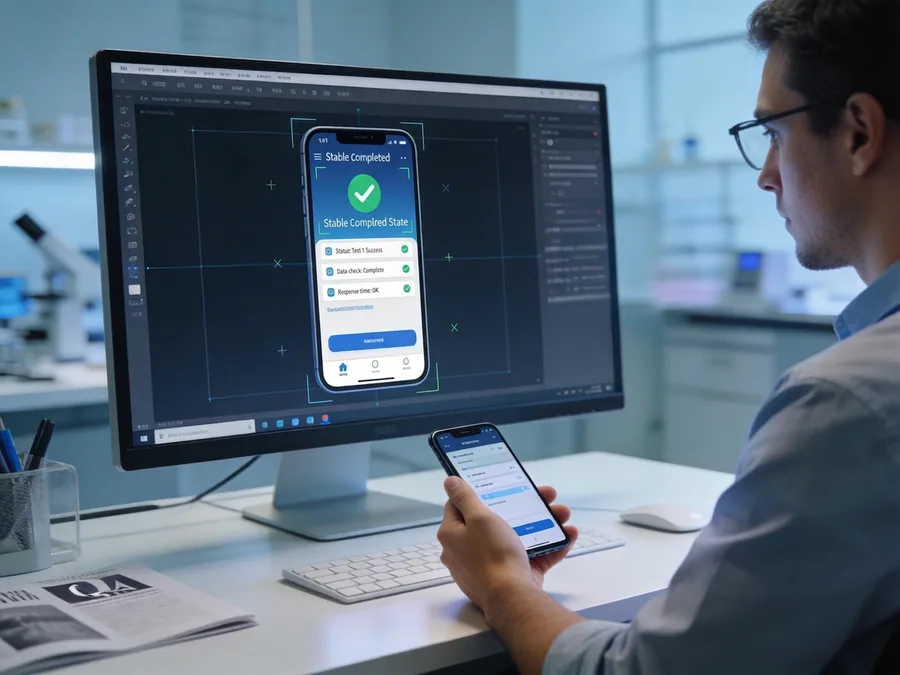
Concordia University thesis-inspired AI testing concept. Credit: Perplexity

Research Summary

A 2025 thesis from Concordia University demonstrates how utilizing advanced AI models, specifically a model called Vision Mamba, can drastically improve the accuracy and efficiency of automated mobile app testing. By allowing testing tools to intuitively "see" when an app screen is fully loaded, developers can eliminate costly testing delays, reduce false error reports, and deliver smoother apps to the market faster.

New AI Approach to Mobile App Testing Promises to Slash Development Bottlenecks

Research Shock

Published on April 3, 2026 at 3:59 am

Summary

A 2025 thesis from Concordia University demonstrates how utilizing advanced AI models, specifically a model called Vision Mamba, can drastically improve the accuracy and efficiency of automated mobile app testing. By allowing testing tools to intuitively "see" when an app screen is fully loaded, developers can eliminate costly testing delays, reduce false error reports, and deliver smoother apps to the market faster.

Anyone who has ever used a smartphone knows the frustration of a glitchy app interface. Behind the scenes, ensuring that buttons, menus, and images load correctly is a massive logistical challenge for software companies. To handle this, developers use automated testing bots to simulate user interactions. However, a recent master's thesis by Ehsan Abdollahi at Concordia University highlights a costly flaw in current automated testing and proposes a powerful AI driven solution.

The Economics of Waiting

In the software industry, time is money. Automated bots interact with an app's Graphical User Interface (GUI), which is the visual layer you tap and swipe. Because mobile screens take time to render depending on network speed or hardware, testing bots are typically programmed with "throttles," which are fixed time delays that force the bot to wait before its next action.

This creates an economic and operational bottleneck. If the delay is set too long, the testing process becomes inefficient, wasting valuable computing resources and prolonging the time it takes to get an app to market. If the delay is too short, the bot attempts to interact with a partially loaded screen, triggering a "false positive" (a reported bug that doesn't actually exist), which engineers must then waste time investigating.

When Simple Tech Fails

To solve this, developers have tried using image comparison tools like the Structural Similarity Index (SSIM) to let the bot decide if a screen is finished loading. SSIM acts like a digital "spot the difference" game, comparing the pixels of an app screen from one millisecond to the next.

However, Abdollahi’s research revealed a glaring issue: SSIM mislabeled the loading state of app screens approximately 30% of the time. Because SSIM only looks at raw pixels, it gets confused by dynamic content, animations, or even minor changes in screen brightness, mistakenly assuming an app is still loading when it is actually ready for use.

Enter Vision Mamba: Teaching Bots to "See"

To cut down on these costly inefficiencies, the research introduces a deep learning approach. Instead of basic pixel checkers, the study fine-tuned "Vision Mamba," a state-of-the-art AI model designed to process visual information.

Unlike older tools, deep learning models like Vision Mamba don't just look at raw pixels; they analyze the semantic features of a screen. This means the AI can understand the context of what it is looking at - differentiating between a spinning loading wheel, an incomplete layout, or a fully loaded interface, much like a human tester would.

Industrial Impact and Results

The results of upgrading to Vision Mamba are significant. In tests across a diverse dataset of mobile applications, the Vision Mamba model achieved an 84% accuracy rate in classifying whether a GUI was fully or partially rendered, drastically outperforming the old SSIM method.

For the tech industry, this represents a major operational upgrade. By integrating models like Vision Mamba into their testing pipelines, development teams can eliminate arbitrary wait times. Bots can dynamically proceed the exact moment an app is fully rendered, maximizing testing speed and minimizing the false bug reports that drain engineering resources.

As mobile applications continue to grow more complex, adopting these advanced, context aware AI tools will be crucial for companies looking to maintain high quality user experiences while keeping development costs in check.

Category

Technology

Tags

Artificial Intelligence, App Development, Automated Testing, Vision Mamba, Deep Learning

Disclosure Statement

This article is based on the findings presented in the master's thesis "Enhancing Automated Testing with GUI Rendering Inference for Mobile Applications" by Ehsan Abdollahi, submitted to the Department of Computer Science and Software Engineering at Concordia University in February 2025.

Research Paper

https://spectrum.library.concordia.ca/id/eprint/995102/

Anyone who has ever used a smartphone knows the frustration of a glitchy app interface. Behind the scenes, ensuring that buttons, menus, and images load correctly is a massive logistical challenge for software companies. To handle this, developers use automated testing bots to simulate user interactions. However, a recent master's thesis by Ehsan Abdollahi at Concordia University highlights a costly flaw in current automated testing and proposes a powerful AI driven solution.

The Economics of Waiting

In the software industry, time is money. Automated bots interact with an app's Graphical User Interface (GUI), which is the visual layer you tap and swipe. Because mobile screens take time to render depending on network speed or hardware, testing bots are typically programmed with "throttles," which are fixed time delays that force the bot to wait before its next action.

This creates an economic and operational bottleneck. If the delay is set too long, the testing process becomes inefficient, wasting valuable computing resources and prolonging the time it takes to get an app to market. If the delay is too short, the bot attempts to interact with a partially loaded screen, triggering a "false positive" (a reported bug that doesn't actually exist), which engineers must then waste time investigating.

When Simple Tech Fails

To solve this, developers have tried using image comparison tools like the Structural Similarity Index (SSIM) to let the bot decide if a screen is finished loading. SSIM acts like a digital "spot the difference" game, comparing the pixels of an app screen from one millisecond to the next.

However, Abdollahi’s research revealed a glaring issue: SSIM mislabeled the loading state of app screens approximately 30% of the time. Because SSIM only looks at raw pixels, it gets confused by dynamic content, animations, or even minor changes in screen brightness, mistakenly assuming an app is still loading when it is actually ready for use.

Enter Vision Mamba: Teaching Bots to "See"

To cut down on these costly inefficiencies, the research introduces a deep learning approach. Instead of basic pixel checkers, the study fine-tuned "Vision Mamba," a state-of-the-art AI model designed to process visual information.

Unlike older tools, deep learning models like Vision Mamba don't just look at raw pixels; they analyze the semantic features of a screen. This means the AI can understand the context of what it is looking at - differentiating between a spinning loading wheel, an incomplete layout, or a fully loaded interface, much like a human tester would.

Industrial Impact and Results

The results of upgrading to Vision Mamba are significant. In tests across a diverse dataset of mobile applications, the Vision Mamba model achieved an 84% accuracy rate in classifying whether a GUI was fully or partially rendered, drastically outperforming the old SSIM method.

For the tech industry, this represents a major operational upgrade. By integrating models like Vision Mamba into their testing pipelines, development teams can eliminate arbitrary wait times. Bots can dynamically proceed the exact moment an app is fully rendered, maximizing testing speed and minimizing the false bug reports that drain engineering resources.

As mobile applications continue to grow more complex, adopting these advanced, context aware AI tools will be crucial for companies looking to maintain high quality user experiences while keeping development costs in check.

Institution

Research Shock

Category

Technology

Tags

Artificial IntelligenceApp DevelopmentAutomated TestingVision MambaDeep Learning

Disclosure statement

This article is based on the findings presented in the master's thesis "Enhancing Automated Testing with GUI Rendering Inference for Mobile Applications" by Ehsan Abdollahi, submitted to the Department of Computer Science and Software Engineering at Concordia University in February 2025.

Research Paper

Read the full research paper

Comments (...)

Loading comments...

Institution

Research Shock

Category

Technology

Tags

Artificial IntelligenceApp DevelopmentAutomated TestingVision MambaDeep Learning

Disclosure statement

This article is based on the findings presented in the master's thesis "Enhancing Automated Testing with GUI Rendering Inference for Mobile Applications" by Ehsan Abdollahi, submitted to the Department of Computer Science and Software Engineering at Concordia University in February 2025.

Research Paper

Read the full research paper