
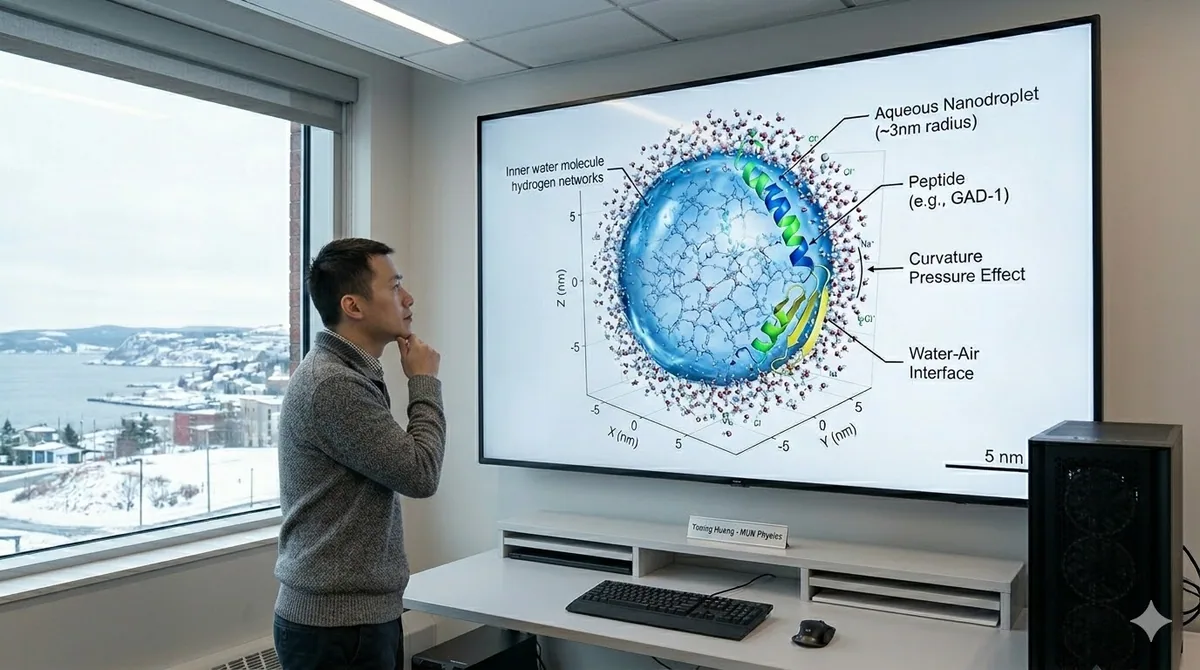
New computational research out of Memorial University is examining how tiny, confined environments alter the behavior of biological molecules. The master's thesis, authored by Yiming Huang, focuses on peptides. Peptides are essentially short chains of amino acids that can undergo spatial rearrangements and fold into specific structures (like helices) depending on their surrounding environment.
Huang's study utilizes all-atom molecular dynamics, a computer simulation technique that mimics the time-dependent motion of individual atoms and molecules using the laws of classical mechanics. Through this method, the research observes what happens to specific peptides when they are confined within nanodroplets—minuscule water droplets just 2 to 3 nanometers in radius. At this microscopic scale, the sharp curvature of the droplet creates an immense internal pressure (roughly 580 times standard atmospheric pressure), fundamentally changing how the water and the peptides inside it interact.
While this is a fundamental biophysics study, the mechanisms it explores have direct economic and industrial applications.
Targeted Drug Delivery and Extracellular Vesicles
The pharmaceutical industry faces challenges in delivering major protein and peptide drugs, such as insulin, because they cannot easily pass through the body's biological barriers when taken orally. To address this, researchers are studying Extracellular Vesicles (EVs). EVs are tiny, naturally occurring cell-like particles enclosed by a membrane that can carry functional biological molecules safely through the body. Because EVs act as nanoscale containers with a water-membrane interface, understanding how peptides fold and behave under similar nanoscale confinement could help in developing EVs as reliable delivery systems and noninvasive diagnostic tools.
Medical Treatments and Antimicrobials
The study looks closely at peptides with specific therapeutic uses. For example, it models CBS peptides, which are known to inhibit cell proliferation by competitively blocking specific cellular signaling. This makes them of high interest for suppressing proliferation in cancer cells and vascular smooth-muscle diseases. The study also models GAD-1, an antimicrobial peptide originally found in the immune system of codfish. GAD-1 is highly sensitive to environmental changes like pH and is being looked at as a therapeutic candidate to treat tumors in skin-like acidic environments. The simulation showed that in nanodroplets, GAD-1 is likelier to form helical structures due to the curved surface of the water.
Mass Spectrometry and Biosensors
The findings also apply to industrial analytical machines. Electrospray Ionization Mass Spectrometry (ESI-MS) is a widely used technology in chemistry that analyzes the masses of molecules. It works by emitting charged liquid droplets that gradually evaporate. Understanding the exact behavior of peptides in evaporating, charged droplets can help refine how these commercial machines operate. Additionally, the rules governing how peptides behave in distinct solvent environments can aid the design of peptide-based biosensors, which are commercial devices used to detect toxins or pathogens.
Modeling Airborne Disease
From a public health and economic perspective, the research touches on the mechanics of airborne disease transmission. When small water droplets (under 50 micrometers) are expelled into the air, they undergo evaporation. As the water evaporates, the substances dissolved inside them become highly concentrated, potentially forming solid or semi-solid nuclei. This drastically changes the local environment for any viruses or molecules trapped inside. Understanding these molecular-level changes helps researchers better assess transmission risks and design effective mitigation strategies.