
iconResearch Shock
Artificial IntelligenceEnvironmentLife SciencesSpaceNeuroscienceEngineeringSocietyTechnologyMedicineBusiness + Innovation

Company

  • Who we are
  • Our team
  • Contact us

Community

  • Community standards
  • Author guidelines

University Partners

  • For Universities
  • For Departments
  • For Research Labs

Legal

  • Privacy policy
  • Terms of service

Follow Us

Copyright © 2025, Research Shock, Inc.

Unmasking the Compressed Lie: New AI Tool Catches Social Media Deepfakes that Others Miss

Unmasking the Compressed Lie: New AI Tool Catches Social Media Deepfakes that Others Miss

Research Shock•Loading...
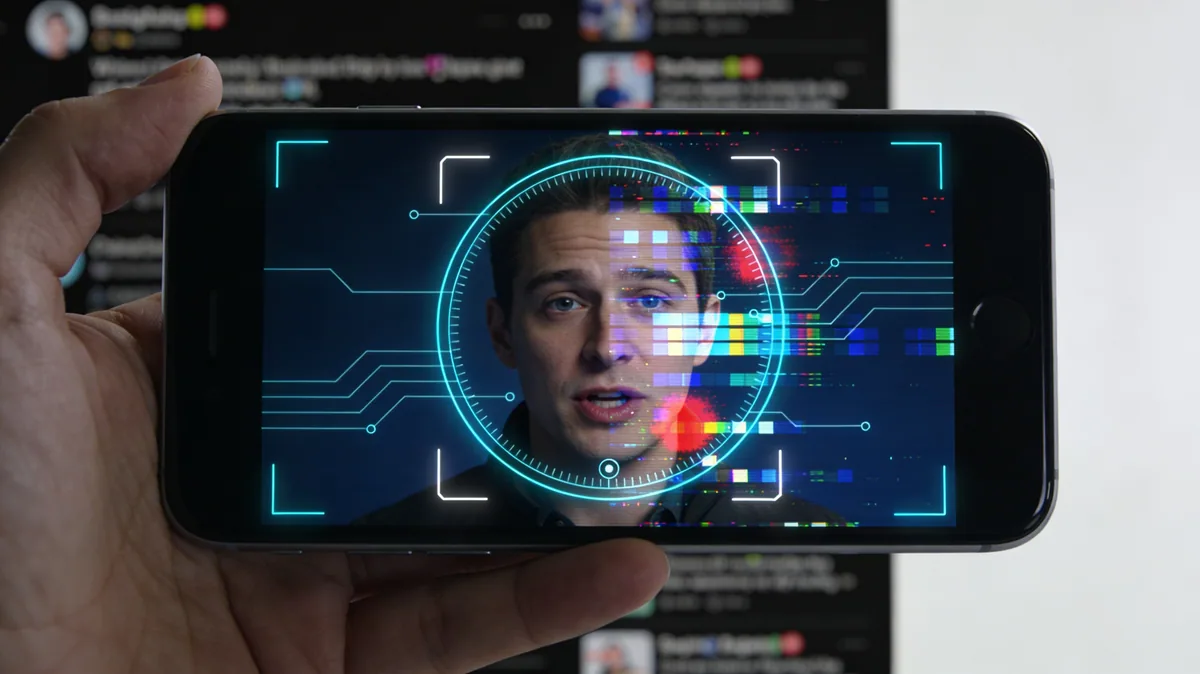
AI finally calls out the perfect fake. Credit: Perplexity

Research Summary

A new master’s thesis from the University of New Brunswick introduces a "hybrid" AI system designed to detect low-quality, compressed deepfakes. Social media compression, which is the process of shrinking a file's size, usually destroys the subtle evidence that standard AI detectors rely on. This new method forces the AI to hunt for "invisible" traces left behind by manipulation, rather than obvious visual flaws. By combining two different neural networks and using a "visibility matrix," the hybrid system achieved an 83% accuracy rate under realistic, highly compressed conditions. Furthermore, it processes images in just 18 milliseconds, making it viable for integration into commercial digital security platforms and enterprise monitoring systems.

Unmasking the Compressed Lie: New AI Tool Catches Social Media Deepfakes that Others Miss

Research Shock

Published on March 25, 2026 at 1:01 am

Summary

A new master’s thesis from the University of New Brunswick introduces a "hybrid" AI system designed to detect low-quality, compressed deepfakes. Social media compression, which is the process of shrinking a file's size, usually destroys the subtle evidence that standard AI detectors rely on. This new method forces the AI to hunt for "invisible" traces left behind by manipulation, rather than obvious visual flaws. By combining two different neural networks and using a "visibility matrix," the hybrid system achieved an 83% accuracy rate under realistic, highly compressed conditions. Furthermore, it processes images in just 18 milliseconds, making it viable for integration into commercial digital security platforms and enterprise monitoring systems.

Deepfakes are getting better, but the real threat isn't just how realistic they look, it's rather how easily they hide in plain sight.

When a manipulated video is uploaded to platforms like X (formerly Twitter), Instagram, or WhatsApp, the file is automatically "compressed". Compression is a technical process that shrinks a file's size to make it load faster, but it does so by deleting fine visual details. For a standard Artificial Intelligence (AI) detector trying to spot a deepfake, this is a nightmare. The subtle clues the AI is trained to look for, like unnatural skin textures or weird lighting, are entirely wiped away by the compression process, causing these security systems to fail.

The unchecked spread of these low-quality deepfakes is no longer just a social issue; it is a direct threat to economic stability and corporate security. Fabricated videos of political figures or corporate executives can ruin reputations, manipulate stock prices, and undermine public trust. As digital identity verification becomes the backbone of modern banking and commerce, the tech industry desperately needs a way to catch these degraded forgeries.

Enter Laleh Sadeghi, a computer science researcher at the University of New Brunswick, who may have cracked the code. In her February 2026 thesis, Sadeghi proposes a "hybrid" deep learning framework designed specifically to hunt down compressed deepfakes.

Instead of relying on one AI model, Sadeghi’s system combines two distinct architectures: known technically as ResNet-50 and EfficientNet-B0. Think of it like a detective team: one model acts as a magnifying glass, looking closely at local details like skin textures and lip boundaries. The other model acts as a wide-angle lens, looking at the big picture for global inconsistencies like lighting and facial symmetry. By fusing their findings together, the system gets a much more accurate read on whether a face is real or fake.

But the real secret weapon of this system is something called a "visibility matrix". Because compression hides obvious visual flaws, the visibility matrix trains the AI to ignore fragile, easily destroyed visual cues. Instead, it teaches the system to hunt for "invisible artifacts" - stubborn, mathematical traces of manipulation that survive the compression process.

The results are highly promising for the computing and cybersecurity industries. Under realistic, highly compressed conditions, older single-model detectors plummeted to a 67% accuracy rate. Sadeghi’s hybrid model, however, achieved a robust 83% accuracy.

Crucially, the system is also built for the real world. Despite running two AI models simultaneously, it requires an inference time (the time it takes the computer to process a single image and make a prediction) of just 18 milliseconds.

This speed and accuracy prove that the system isn't just a lab experiment. It is computationally efficient enough to be integrated into live, automated media monitoring systems, visual identity verification, and digital security platforms. As the arms race between deepfake creators and cybersecurity professionals continues, Sadeghi's work offers a practical, much needed shield for the digital economy.

Category

Technology

Tags

Deepfakes, AI Security, Digital Forensics, Tech News, Enterprise Security

Disclosure Statement

Information and statistics in this article are sourced directly from the February 2026 master's thesis Enhancing Low-Quality Deepfake Detection Using Hybrid Deep Learning Models by Laleh Sadeghi, University of New Brunswick.

Research Paper

https://unbscholar.lib.unb.ca/items/e1b9b27e-f452-4762-87f5-1e34deaab58b

Deepfakes are getting better, but the real threat isn't just how realistic they look, it's rather how easily they hide in plain sight.

When a manipulated video is uploaded to platforms like X (formerly Twitter), Instagram, or WhatsApp, the file is automatically "compressed". Compression is a technical process that shrinks a file's size to make it load faster, but it does so by deleting fine visual details. For a standard Artificial Intelligence (AI) detector trying to spot a deepfake, this is a nightmare. The subtle clues the AI is trained to look for, like unnatural skin textures or weird lighting, are entirely wiped away by the compression process, causing these security systems to fail.

The unchecked spread of these low-quality deepfakes is no longer just a social issue; it is a direct threat to economic stability and corporate security. Fabricated videos of political figures or corporate executives can ruin reputations, manipulate stock prices, and undermine public trust. As digital identity verification becomes the backbone of modern banking and commerce, the tech industry desperately needs a way to catch these degraded forgeries.

Enter Laleh Sadeghi, a computer science researcher at the University of New Brunswick, who may have cracked the code. In her February 2026 thesis, Sadeghi proposes a "hybrid" deep learning framework designed specifically to hunt down compressed deepfakes.

Instead of relying on one AI model, Sadeghi’s system combines two distinct architectures: known technically as ResNet-50 and EfficientNet-B0. Think of it like a detective team: one model acts as a magnifying glass, looking closely at local details like skin textures and lip boundaries. The other model acts as a wide-angle lens, looking at the big picture for global inconsistencies like lighting and facial symmetry. By fusing their findings together, the system gets a much more accurate read on whether a face is real or fake.

But the real secret weapon of this system is something called a "visibility matrix". Because compression hides obvious visual flaws, the visibility matrix trains the AI to ignore fragile, easily destroyed visual cues. Instead, it teaches the system to hunt for "invisible artifacts" - stubborn, mathematical traces of manipulation that survive the compression process.

The results are highly promising for the computing and cybersecurity industries. Under realistic, highly compressed conditions, older single-model detectors plummeted to a 67% accuracy rate. Sadeghi’s hybrid model, however, achieved a robust 83% accuracy.

Crucially, the system is also built for the real world. Despite running two AI models simultaneously, it requires an inference time (the time it takes the computer to process a single image and make a prediction) of just 18 milliseconds.

This speed and accuracy prove that the system isn't just a lab experiment. It is computationally efficient enough to be integrated into live, automated media monitoring systems, visual identity verification, and digital security platforms. As the arms race between deepfake creators and cybersecurity professionals continues, Sadeghi's work offers a practical, much needed shield for the digital economy.

Institution

Research Shock

Category

Technology

Tags

DeepfakesAI SecurityDigital ForensicsTech NewsEnterprise Security

Disclosure statement

Information and statistics in this article are sourced directly from the February 2026 master's thesis Enhancing Low-Quality Deepfake Detection Using Hybrid Deep Learning Models by Laleh Sadeghi, University of New Brunswick.

Research Paper

Read the full research paper

Comments (...)

Loading comments...

Institution

Research Shock

Category

Technology

Tags

DeepfakesAI SecurityDigital ForensicsTech NewsEnterprise Security

Disclosure statement

Information and statistics in this article are sourced directly from the February 2026 master's thesis Enhancing Low-Quality Deepfake Detection Using Hybrid Deep Learning Models by Laleh Sadeghi, University of New Brunswick.

Research Paper

Read the full research paper