
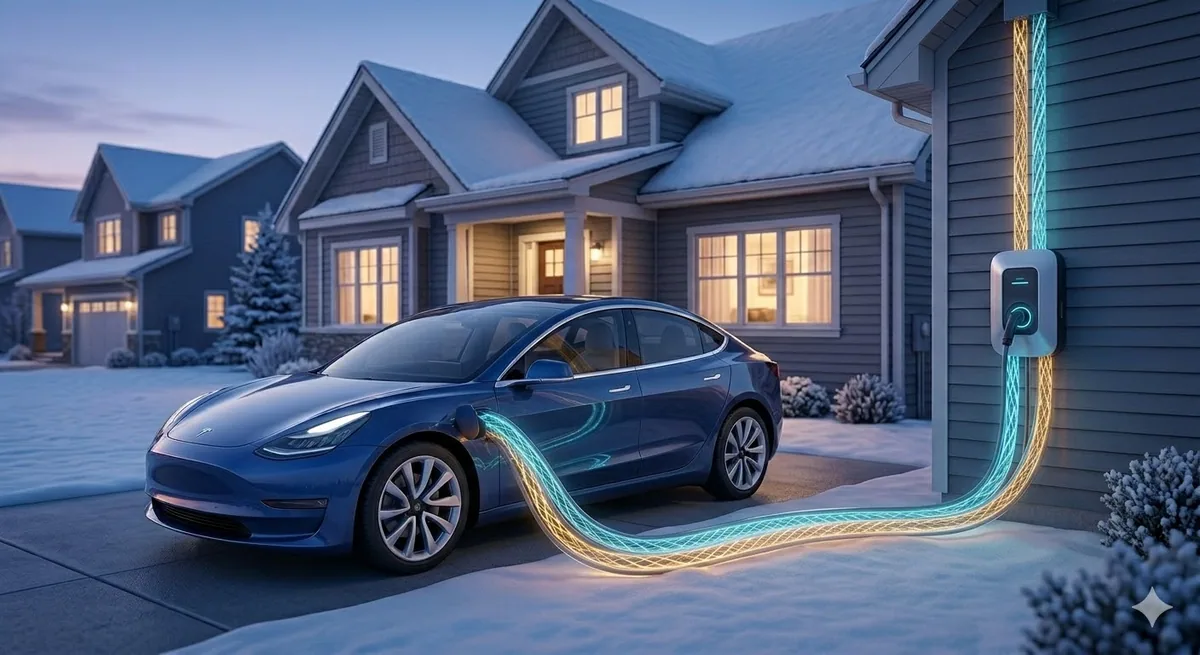
The shift away from gas-powered cars is accelerating, but it brings a massive hidden challenge regarding how our cities will generate enough electricity to charge millions of new electric vehicles at the same time. If entire neighborhoods plug in their cars after work, the sudden spike in energy demand could easily overwhelm the power grid. A team of researchers at the Future Urban and Energy Lab for Sustainability at the University of Prince Edward Island has developed a blueprint to turn this massive problem into a solution.
To fully grasp their solution, it helps to understand a few key concepts. The first is a microgrid, which is essentially a localized version of a city's main power grid that connects a specific neighborhood's homes, solar panels, and chargers together, allowing them to share power locally. The second concept is bidirectional charging. Traditionally, charging goes one way, from the wall to the car. Bidirectional means two-way, meaning the car can draw power from the grid to charge, but it can also send power back out of its battery to run a house or support the neighborhood.
This plays into managing peak demand, or peak load, which is the time of day when a neighborhood uses the most electricity. This usually happens in the early morning when people wake up, or in the evening when everyone gets home, turns on the heat or air conditioning, and starts cooking. The UPEI framework focuses on peak load shaving, which is the act of smoothing out that massive spike in demand. If you can provide extra power from a battery during the peak demand time, the main power grid doesn't have to work as hard.
The UPEI researchers built a highly advanced computer simulation of a 48-home neighborhood to see what would happen if all the cars were plugged into a bidirectional microgrid. They created specific Electric Vehicle Profiles based on real human habits. Some profiles represented people who commute long distances, some represented people who work night shifts, and others were people who stay at home.
The simulation constantly monitored each vehicle's battery percentage level. The system was smart enough to know when to pull power from the cars to help the neighborhood, and when to safely recharge the cars during quiet, off-peak hours like the middle of the night. The results were remarkable. During the harsh winter simulation, the parked cars automatically sent power back to the homes between 1 am and 6 am, completely eliminating the dangerous early-morning spike in electricity demand. The cars then safely recharged themselves later when the neighborhood was using less power.
Economic and Industrial Use
For the energy industry, municipalities, and smart-city developers, this research presents a highly lucrative economic roadmap. The research showed that if electric vehicle owners plug in and charge randomly, it causes the local power grid to overload by up to 18 percent. Preventing these overloads through coordinated bidirectional charging means utility companies can avoid, or significantly delay, the multi-million dollar costs of building new power substations and laying heavier power lines.
To make this system work, drivers need a reason to let the grid use their car batteries. The researchers created a scoring system called the EVP Peak Support Index, which acts a lot like a rewards program. It measures exactly how much energy a specific car gave back to the neighborhood during critical times. Utility companies can use this exact math to pay drivers directly, offering seasonal bonuses or reduced electric bills to those who help stabilize the grid.
Furthermore, this research provides the logic needed for tech companies building the next generation of chargers. The chargers of tomorrow will need built-in algorithms that can instantly decide whether to charge a car or pull power from it, based on the real-time needs of the neighborhood microgrid. By treating electric vehicles not as a burden, but as a massive, mobile network of community batteries, the UPEI framework proves that the smart neighborhoods of the future can be highly resilient and economically efficient.